

The drive from Dubai to Muscat is one of the most rewarding road trips in the Gulf: modern highways, dramatic mountain stretches, and a capital city that feels worlds away from Dubai’s skyline. But it is also an international border crossing, and that is where most travellers get caught out. The wrong visa type, a missing document, or a queue you didn’t plan for can turn a smooth journey into a stressful one.
This guide walks you through all of it: the exact route, the realistic travel time, the documents you must carry, the border process step by step, and the one visa mistake that catches people every year. By the end you will know precisely what to prepare, and why letting a cross-border chauffeur handle the paperwork and the wheel is the simplest way to make the trip.
One important note up front: visa rules depend on your nationality and change from time to time. Treat this guide as a planning overview, and always confirm the current requirements for your passport on the official Royal Oman Police (ROP) eVisa portal before you travel.
The Route: How You Actually Get from Dubai to Muscat
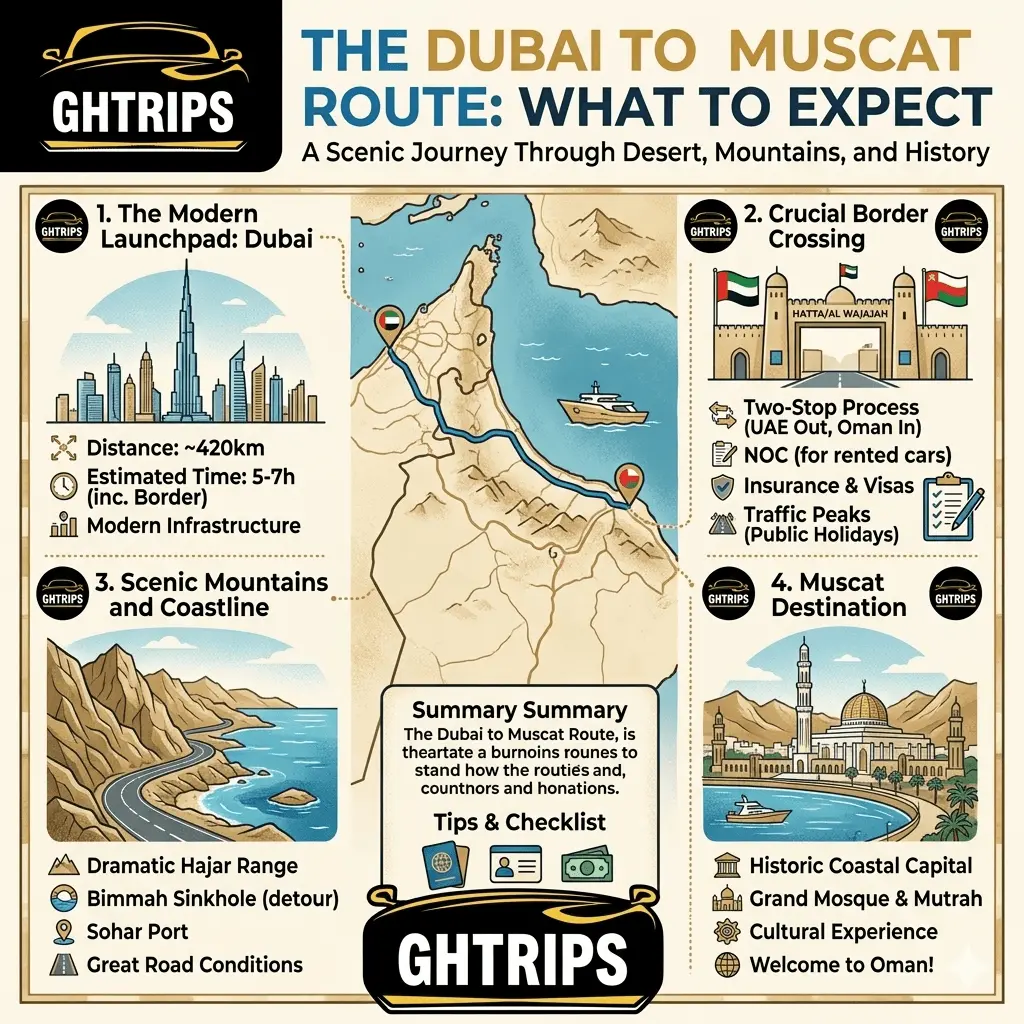
There is one main, well-trodden route, and it is the one experienced drivers use because it balances speed with the smoothest border experience.
Distance, roads, and the Hatta / Al Wajajah border
The road distance is roughly 450 to 480 kilometres depending on your exact start and finish. From central Dubai you take the E611 (Emirates Road) towards Hatta, cross into Oman at the Hatta / Al Wajajah checkpoint, then continue on Oman’s well-maintained highways through the Sohar region and down into Muscat. A useful thing to know: the UAE side of this crossing is called Hatta and the Oman side is officially Al Wajajah, but they are the same checkpoint, so don’t be confused if you see both names. This is the route our Dubai to Muscat car with driver service uses by default.
How Long Does the Dubai to Muscat Drive Take?

Realistic timing, including the border
Plan for about 5 to 6 hours door to door. The pure driving time is around 4.5 to 5 hours, and the border crossing typically adds 30 to 60 minutes depending on traffic and how busy the checkpoint is. Crossings tend to be slower around weekends, public holidays, and Omani or UAE long weekends, when thousands of people make the same trip. Building a buffer into your schedule, especially if you have a flight or meeting in Muscat, is always wise.
The best time of day to leave
Leaving Dubai early, before around 7:00 AM, gives you the lightest highway traffic and the shortest border queues, and gets you into Muscat with daylight to spare. A mid-morning departure around 10:00 AM is the next best option. Avoid setting off into the late afternoon if you can, as you risk both rush-hour traffic leaving the UAE and a long mountain drive in the dark on the Oman side.
Documents You Need to Cross into Oman
This is the part worth getting right before you leave. Carry the following, and keep digital and printed copies where sensible:
- A passport valid for at least six months beyond your entry date
- Your Oman visa, either an approved eVisa copy or eligibility for a visa on arrival (see below)
- Your UAE residence visa and Emirates ID, if you are a UAE resident
- A recent passport-size photograph, occasionally requested
- Proof of onward or return travel and accommodation details, sometimes requested
- For any vehicle, valid registration and Oman-valid insurance, which a chauffeur service already provides
Your Oman visa: eVisa vs visa on arrival
There are two common paths. A 30-day unsponsored eVisa, applied for in advance through the ROP portal, costs roughly USD 88 and suits longer stays. Eligible UAE residents of certain nationalities can instead get a 14-day visa on arrival at the border for a much smaller fee, around OMR 5. Crucially, eligibility for visa on arrival depends on your nationality, your profession as listed on your Emirates ID, and your UAE residency, so it is not automatic. If you are applying for an eVisa, do it several days ahead, as approval can take anywhere from 24 to 72 hours and sometimes longer.
The single-entry UAE visa trap to avoid
Here is the mistake that catches people out. If you are in the UAE on a single-entry visit visa and you exit through the Hatta border, that visa is consumed the moment you leave, and you will need a brand-new UAE visa to get back in. This does not affect UAE residents with a valid residence visa, but visit-visa holders must check their visa type before crossing. It is the single most common and most expensive surprise on this route.
Exit fees, cash limits, and what to carry
Expect a UAE exit fee of around AED 35 per person, collected at the border when you leave. Be mindful of cash declaration limits too: the UAE allows up to roughly AED 3,000 and Oman up to OMR 6,000 to be carried without declaration, and amounts above that must be declared. Carry a little local cash for incidentals, though card payment is widely accepted in Muscat.
The Border Crossing, Step by Step
The crossing is straightforward once you know the sequence. In practice it looks like this:
- UAE exit: you drive to the exit lane, hand over passports, and pay the exit fee while your driver handles the vehicle exit formalities
- No-man’s-land: a short drive from the UAE post across to the Oman entry point
- Oman entry: you present your eVisa copy, or are issued a visa on arrival if eligible, and your passport is stamped
- Vehicle check: a brief inspection of the vehicle may take place before you are waved through
- Onward to Muscat: once cleared, you continue on Oman’s highways towards the capital
With an experienced chauffeur, you stay in the vehicle for most of this and simply present your documents when asked. The driver knows which lane to use, which window to approach, and how to keep the process moving.
Why a Cross-Border Chauffeur Beats Self-Drive and Shared Taxis

The vehicle insurance and permit problem
If you take a standard rental car across the border, you cannot just drive off. The rental company must supply a No Objection Certificate, Oman-valid insurance, and explicit cross-border permission, and arranging all of that takes time and often extra fees. Many rentals simply don’t allow it. A shared taxi, meanwhile, means waiting for the vehicle to fill and sharing the long drive with strangers.
What a chauffeur handles for you
A proper cross-border chauffeur service removes every one of these headaches. The vehicle is already licensed and insured for UAE–Oman travel, the driver crosses this border regularly and knows the routine, and you get door-to-door pickup and drop-off without changing vehicles. Our Dubai to Oman by road service is built precisely for this: border-ready vehicles, drivers experienced with the Al Wajajah checkpoint, and a single fixed price covering the journey. You can read more route and distance detail on our Dubai to Muscat distance guide.
Choosing Your Vehicle for the Long Drive
On a five-to-six-hour journey, comfort is not a luxury, it is the whole point. For couples or business travellers, an executive sedan like the Mercedes-Benz S-Class or BMW 7 Series turns the drive into rest or productive time. Families and groups with luggage are better suited to a spacious SUV such as the GMC Yukon Denali or Toyota Land Cruiser, which handle the mountain stretches with ease. Travelling as a larger party? A van keeps everyone together, and for big groups there is even a luxury bus from Dubai to Muscat. Browse the options on our fleet page.
How to Book Your Dubai to Muscat Chauffeur
Because this is a cross-border trip, booking ahead matters more than usual, so the driver, vehicle, and border paperwork are all squared away before you travel:
- Tell us your Dubai pickup point, your Muscat destination, and your travel date
- Choose your vehicle based on group size and luggage
- Confirm your own visa arrangements in advance using the ROP portal
- Receive a fixed, all-inclusive transport quote, with the vehicle border-ready
Heading elsewhere in Oman? The same team covers the wider country through our chauffeur service Dubai to Oman, and you can always contact us for a custom multi-day or return quote.
Frequently Asked Questions
How long does it take to drive from Dubai to Muscat?
Around 5 to 6 hours door to door. The driving itself is roughly 4.5 to 5 hours, with the Hatta / Al Wajajah border crossing typically adding 30 to 60 minutes depending on how busy it is.
Do I need a visa to drive from Dubai to Muscat?
Most non-Emirati travellers need an Oman visa. Options include a 30-day eVisa applied for in advance, or a 14-day visa on arrival for eligible UAE residents. Eligibility depends on your nationality and residency, so always confirm current rules on the official Royal Oman Police eVisa portal before travelling.
What documents do I need at the border?
Generally: a passport valid for at least six months, your Oman visa or visa-on-arrival eligibility, your UAE residence visa and Emirates ID if you are a resident, and sometimes a passport photo and proof of onward travel. The vehicle also needs Oman-valid insurance, which a chauffeur service provides.
Can I take a normal rental car across the UAE–Oman border?
Only if the rental company supplies a No Objection Certificate, Oman-valid insurance, and cross-border permission, and many do not. A cross-border chauffeur avoids this entirely because the vehicle is already licensed and insured for the route.
Will exiting the UAE by road affect my UAE visa?
If you are on a single-entry UAE visit visa, exiting by land consumes that visa and you will need a new one to re-enter. UAE residents with a valid residence visa are not affected. Always check your UAE visa type before crossing.
What’s included when I book a Dubai to Muscat chauffeur?
A fixed all-inclusive price covers the border-ready vehicle, a professional driver, fuel, and tolls. Your Oman visa fee and the UAE exit fee are paid by you and are not part of the transport rate. Share your plan when booking for an exact quote.
Final Word: Cross the Border the Easy Way
Dubai to Muscat is a genuinely beautiful drive, but it is also an international crossing with real paperwork behind it. Get your visa sorted in advance, carry the right documents, watch out for the single-entry visa trap, and the rest is simple. Hand the border formalities and the long mountain drive to a professional, and what could be a stressful logistics exercise becomes a comfortable, scenic journey.When you are ready, you can book your Dubai to Muscat car with driver here, explore the wider Dubai to Oman by road options, or get in touch with our team to plan your crossing. Sort the visa, pack your passport, and leave the border to us.